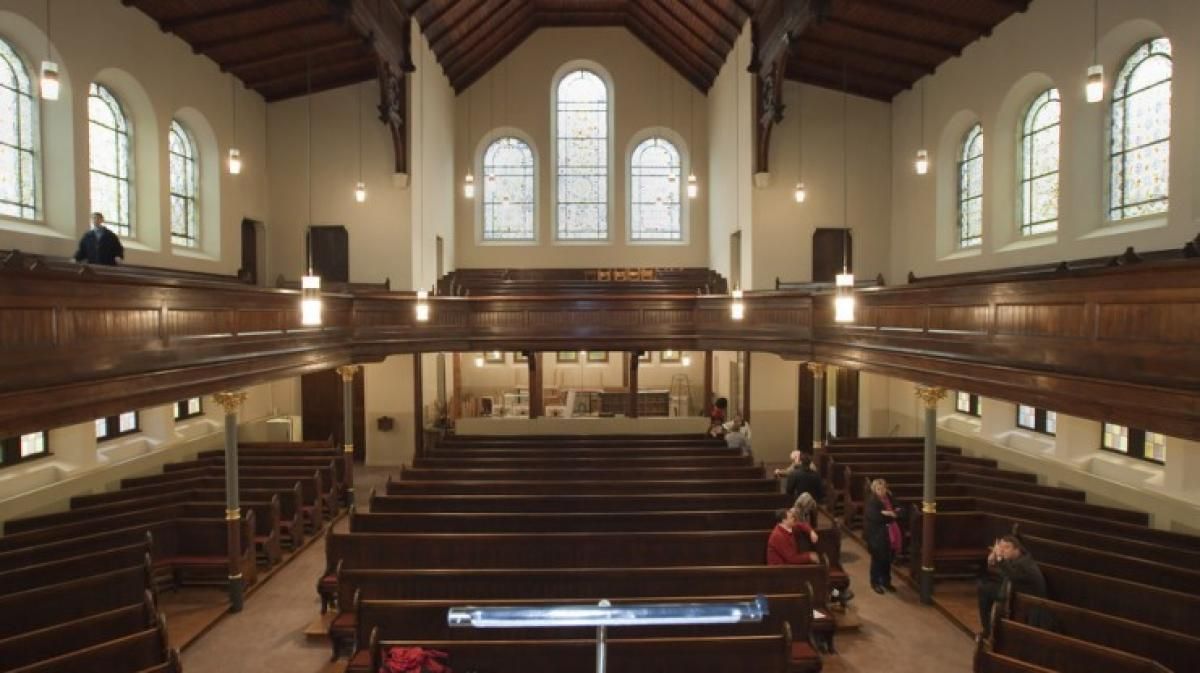
Bergkirche
The Bergkirche is part of the cityscape of Osnabrück. On the edge of the old town, near the Heger Gate and opposite the cultural history museum, it stands in an exposed location at the foot of the Westerberg. Its striking tower, covered with red bricks, is visible from afar. The quarry and house stone masonry made of yellowish shell limestone and sandstone refers to the local building tradition, but the structure of the building already shows the peculiarity of this church from the outside.
The Bergkirche is the first new Protestant church building in Osnabrück since the Reformation. It was built in the years 1892/93 according to the plans of the renowned Berlin architect Otto March (1845–1913). The still young but strongly growing Protestant-reformed community in the city did not have its own church until then. The architectural competition, which she organized in 1891, attracted great attention among experts and the German public, as the church board did not appropriate the views and norms that were still prevailing at the time in the field of church construction. Instead of emulating the model of medieval sacred architecture in romantic transfiguration, the congregation wanted to build a church that would correspond to their liturgy and design of the service and their needs.
The church created by Otto March was something new in Germany at the time. By connecting the church room, community rooms, the rectory and the sacristan's apartment to form a structural unit, the mountain church appears as a precursor of the later many-established group buildings and the modern community centers.
In recent years, extensive construction and renovation measures have taken place in the church interior of the Bergkirche. The original paintings on the pulpit wall were also exposed again and elaborately restored.
Website